Marry MCALISTER 2024
HISTORY OF GBS AND MARY MCALISTER
My own GBS story might be interpreted as a comparison of the “then” and the “now”. A contrast and the challenges of a GBS diagnosis in 1948 compared to a GBS diagnosis in 2024.
The simple truth is a diagnosis of GBS and the presentation of symptoms in GBS patients, present exactly in the same manner from the time it was first described in 1859 to present time. More recent studies have recognised there are several variances of the syndrome and the recovery possibilities are better understood. What is different from then to now, is how it is managed medically in today’s terms.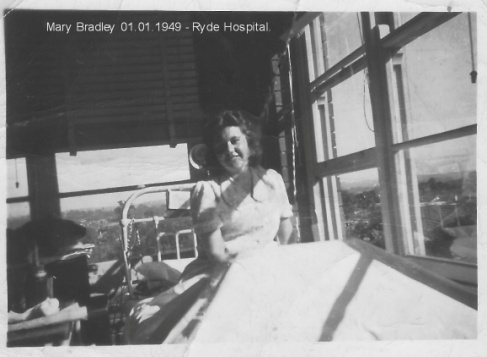
In 1948, I was fifteens year old, on school holidays in Tasmania with my parents a younger brother and friends of my parents, all travelling together in my father’s old Buick car which surprisingly adequately held the six people.
During the three weeks of our family holiday, I had a very heavy bronchial flu/cold. which although was on the mend I was still very lethargic. On Monday 26th January 1948, my family and friends set off from Hobart to the West Coast, of Tasmania, and planning to wind our way back to Launceston to meet the Ferry to return home. It was a fateful journey for me, by midday lunch break, I could barely walk, just able to drag myself with heavy cement blocks for feet; by evening I could not walk at all, my dad piggy-backed me upstairs to our accommodation on the upper level. All the time my paralysis deepening. The next day it was much more profound my hands, my head all now weak. A local Dr. was called… who just said “get her to a bigger hospital as soon as possible” As it turned out very good advice.
On Wednesday 28th January 1948, after an all day nightmare car journey we arrived late to Launceston. I was admitted to Launceston Tasmania General Hospital with absolute and total paralysis. By then, all thought of my having a transitory condition was inconceivable, I was seriously unwell. .
I was admitted to the Isolation section of Launceston Hospital which was some distance from the hospital itself. A month later whilst still critically ill I was infected by a nurse with what was serious case of Scarlet Fever. This probably was my absolute lowest point of my time as a patient. It is my belief Scarlet Fever then added to my slow recovery.
The pain and the trauma of my GBS experiences are to this day still confronting, and are best not described; it serves no benefit or purpose to expand further, just to say I liken it to be the living dead.
However the treatment procedure may be of interest. Launceston hospital had one iron lung permanently occupied. Tracheostomy unheard of procedure. Penicillin for the Scarlet Fever only just filtering into public hospitals, so was not available to me. My only sustenance was a very small piece of blackcurrant jelly set very firm, pushed into my cheek, to somehow slip slowly down my gullet most of it dribbled out my mouth. I was always conscious. I barely slept. I was called the Belsen Horror (a war reference). There was no intervention procedures at all. Except:-my physio treatment.
If one could find positives at that stage, there was indeed one. The physiotherapist at the Hospital an ex-army Colonel from WW2. Specialising in war recovery of wounded soldiers. For all intents and purposes I was indeed wounded. Miss Mack immediately ordered a full cast of my whole body from the back of my neck to the back of my knees, with my arms set at right angles to my trunk, obviously allowing for toileting. This procedure of making the cast was one I rather forget. My feet had plaster boots that met the body cast, and my arms and hands also in plaster casts.. the boots and the hand splints were bandaged on and taken off only when having physio. The plaster cast and me had to be raised on a wooden platform high enough for toileting. Before I was placed in the cast the pain of lack of ability to even twitch caused great me great distress -- the plaster cast actually as primitive as it seems, did help to alleviate that.
In late March 1948 I was deemed fit enough to be air-vacced back to Sydney in my body cast. I was met at the airport by an ambulance and very late that day I was admitted to Ryde District Hospital. For the next 9 months I remained in my plaster case, from which I was lifted daily to have a bed bath and have my physio. The plaster cast was replaced in about September 1948 with a metal and leather frame into which I was strapped, my arms still in the aeroplane format… This meant my forearms were always at right angles to my body actually sticking out and up in all seasons… Naturally in winter my forearms lost blood and became rigid with cold… My Dad bought some lamb skin with the fleece which he made a pouch to cover both forearms. Which dear dad that helped. So the months dragged on about July my eyes, and eyelids recovered, then my head I could turn to one side, my hands always had a great deal of attention both in massage, and exercise. On my sixteenth birthday the nurses put on my new pair of pyjamas, till then I had always worn a hospital gown; did my hair, which had fallen out due to Scarlet Fever and took my photo.
It was to be May 1949 before I actually had enough body splint support to allow me to stand.
I was discharged in July 1949 with full leg callipers, a body corset to hold me upright, nonetheless, being discharged. The callipers went right up to the groin, with toe to knee spring attached for my foot drop. The full callipers did not bend at the knee… It was a stiff dolly-legged walk. impossible to make a step up or down. Still I was walking. In 1950 I graduated from long callipers to shorter under the knee type with springs still attached. This was progress indeed although obviously limited. Now 17 years old still an outpatient for physiotherapy each day for about another year. As the years passed my physio reduced to three times a week. At 23 years old when I married Arthur, I was still going to hospital for my physio. I still had not been told I had Guillain Barre Syndrome.
That diagnosis came when I was about 32 years old. When I visited a Neurologist about another matter… he said ..”when did you have Landry’s Ascending Poliomyelitis ?” I did not know I had. It is now known as Guillain Barre Syndrome…So it was much later in my life my condition had a name. I remember writing his words down on a slip of paper I still have. To know what I had was important, but my Dad had died I could not tell him, that I regretted; my Mum said “ it is all too late” .
Knowing a name did not change my life, I was now a wife, mother of three daughters and those early years a blocked memory… I still had not met another GBS person.
In 1989 providence changed my life; Sydney University, and Prof. James G. McLeod invited a number of GBS patients known to him, to a meeting at the University. For the first time I met other GBS persons some with ramifications similar to myself, others more recovered. I was now 56 years old. From that meeting the NSW GBS Association had its early beginnings and a new chapter in my life.
I did not ever regain the pre 1948 physical person, what I did gain was a positive approach, to do what I can as well as I can attitude which serves me well to this day.
So that was the “then” -- to day a GBS diagnosis will probably be immediately treated with either of two options. Plasmapheresis or IVIG infusions. More likely IVIG as it is easier to administer. The introduction of plasmapheresis in 1974 was the first step to provide that important intervention procedure which aimed to filter out the anti-bodies from the blood, which causes the damage to the myelin sheaths of the peripheral nerves and subsequent paralysis. IVIG works by enhancing the immune system to fight the anti-bodies. Both thought to be equally successful.
I have not ever had a Neurologist or Haematologist attending me -- the Doctors who did attended me in 1948/1950 were Orthopaedic surgeons… .. that is my story…. still in there giving it a try… Mary McA